A Legacy of Prestige and Innovation

From our humble beginnings to rising as Thailand's National Carrier, explore the remarkable story of our path to global success.

On December 31, 2023, Thai Smile Airways officially merged into Thai Airways International (THAI) as part of the airline’s fleet and service integration strategy. The full cessation of THAI Smile’s operations took effect on January 1, 2024.

As part of the merger, 20 Airbus A320-200 aircraft were transferred to THAI’s fleet, enabling the airline to enhance its regional network while maintaining efficiency and service quality. This integration aimed to streamline operations, optimize resources, and provide passengers with a more seamless travel experience under the THAI brand.

Marking 60 years of "Smooth as Silk," THAI remained committed to reconnecting the world despite the challenges of the COVID-19 pandemic, continuing to serve key domestic destinations while maintaining its international presence across Asia, Europe, and Australia.
The THAI Royal Orchid Prestige Lounge was opened, providing a new level of comfort and luxury for passengers.
THAI launched a new destination to Busan. The airline also introduced a mobile app for enhanced customer convenience.
Flights to Vienna, were reinstated, marking the return of this key European destination.
The "Samrab Thai" menu was introduced for Royal Silk Class passengers, offering a premium Thai culinary experience. Additionally, the direct flight route to Moscow was resumed.

THAI expanded its network with a new route to Brussels, further strengthening its presence in Europe.

In July 2012, Thai Smile Airways was launched as a regional carrier offering light-premium services, bridging the gap between low-cost carriers and full-service airlines.

THAI placed a significant aircraft order, including Boeing 777-300ER, Airbus A350, and Airbus A320 models, enhancing its fleet capacity and efficiency.
From just 36-year-old Douglas DC turboprop airplanes with a capacity of 60 seats flying to 3 cities 50 years ago to being the world's leading airline with the most incredible network of airline partners. of the world today. Even though the aviation business world is currently in a state of high volatility, Thai Airways is still Committed to providing non-stop customer service. As the national airline, the airline that customers choose first has excellent service and Thai charm, including expanding new flight routes to accommodate passengers worldwide.

On December 25, 2009, THAI took a step toward environmental responsibility by introducing carbon footprint labeling on in-flight meal containers. This initiative highlights the carbon dioxide emissions associated with each meal, encouraging passenger awareness and cooperation in reducing greenhouse gases.

The labeled menus include Massaman curry with jasmine rice, chicken green curry with jasmine rice, pork panaeng, roast duck red curry, chicken with basil, and ruby fish chu chee.

In the same year, THAI expanded its European network by launching direct flights to Oslo, marking its 13th destination in Europe.

This year, THAI Catering signed a Memorandum of Understanding (MoU) with the Islamic Committee of Samut Prakan Province to certify its kitchens for Halal food preparation. This ensures that Muslim passengers receive meals that fully comply with Islamic principles.

Trained Muslim staff oversee raw materials and meal preparation, ensuring strict adherence to Halal standards. THAI Catering has also expanded its Halal meal service to 10 Muslim airlines and other carriers upon request.

THAI commenced full operations at Suvarnabhumi Airport while continuing to support the government’s policy by maintaining domestic flights from Don Mueang Airport.

In the same year, THAI’s Royal First Class Lounge at Suvarnabhumi Airport was named “Best in the World” by the Skytrax World Airline Survey, recognizing its exceptional service and luxury.

THAI also expanded its network with new routes to Gaya and Varanasi, catering to passengers traveling on pilgrimage journeys.

THAI connected airspace across all five continents and launched a non-stop route to Johannesburg, South Africa, strengthening its global network.

On September 28, 2006, THAI relocated operations to Suvarnabhumi Airport (now Bangkok International Airport), moving over 1.8 million pieces of equipment and key departments, including THAI Technicians, THAI Catering, THAI Ground Services, Warehousing, and Operations.

As part of this transition, THAI unveiled a state-of-the-art THAI flight kitchen near the airport, capable of producing 87,000 meals daily. The facility also provides apron and ground services to over 80 airlines, reinforcing THAI’s role as a leading aviation service provider.

After three decades, THAI refreshed its brand identity, marking a significant transformation. The iconic symbol was refreshed with deeper, richer shades of purple, golden yellow, and vibrant magenta, enhancing its elegance and sophistication. The word "THAI" was prominently displayed in uppercase letters, symbolizing the airline’s strength, stability, and unwavering commitment to excellence.

That same year, THAI expanded its network with non-stop flights from Bangkok to New York, Los Angeles, and Moscow, reinforcing its global presence.

As competition in the aviation industry intensified across the region, THAI implemented a key strategy by launching Nok Air, a low-cost airline in which it held a 39% majority stake. Nok Air was established to expand domestic routes and compete with other budget carriers in the market.

Meanwhile, THAI celebrated a successful year, reporting a profit of 12,453 million baht and expanding its network with new routes to Milan and Bangalore.

THAI supported the transportation of two giant pandas, Chuang Chuang and Lin Hui, from the People's Republic of China by operating a special Airbus A330-300 flight. These pandas, serving as goodwill ambassadors, were safely brought to Thailand.

Additionally, THAI expanded its fleet with the addition of two Boeing 747-400 aircraft. The airline also successfully secured new co-investors, both domestic and international, with a total investment value of 285 million baht.

As part of its expansion, THAI introduced new flight routes to Shanghai, China; Chennai, India; and Luang Prabang, Laos.

Policy for expanding new flight routes of THAI continues to operate to create opportunities for business for the company. To give customers more options for traveling with THAI, we therefore opened two new flight routes to Chengdu, People's Republic of China, and Busan, South Korea. In this same year, Plane manufacturer Airbus awarded a record-breaking award to THAI Airbus A330-300 aircraft. Technical reliability is as high as 99.4 percent.
Thai Airways added two more Boeing 747-400 aircraft to its fleet and began implementing the project. Customer Relations (Customer Relationship Management - CRM) to respond to needs and messages relationship with customers as expected, Thai Airways has expanded cooperation in aviation within the country. And regions through global aviation partners, Including opening a flight route to Mumbai. India

At a time when people around the world were concerned about the Y2K situation, THAI had been preparing its data systems (Data Processing) for three years in advance. This proactive approach allowed THAI to navigate the situation smoothly.

In the same year, THAI launched its Royal e-Service, enabling passengers to make seat reservations, issue tickets, pay fares, and check in electronically.

The auspicious year of His Majesty the King's 6th cycle birthday, Thai Airways International (THAI) and the Thai people celebrated by stamping the royal emblem on every plane and painting a picture of the Suphannahong Royal Barge on a Boeing 747-400 plane and a picture of a Narai Songsuban Royal Barge on an Airbus A330-300 aircraft with the skills of THAI technicians.
Measures to devalue the baht have caused more foreign tourists to flow into Thailand. This year is the Amazing Thailand travel year. THAI has organized various activities. THAI flower parade under the concept of Amazing Thailand in the Rose Parade in Pasadena. California, United States, won the first prize. Which has created a reputation for Thailand throughout the world
On May 14, 1997, THAI became a founding member of the Star Alliance, a network of premier airlines. The most significant water in the world. This grouping increases the strength and potential of the aviation business, allowing THAI to serve more passengers and offer more flight spots. The founding members of the participating airlines are Air Canada, Lufthansa, Scandinavian Airlines, Thai Airways International, and United Airlines. THAI is the first Asian airline to join the alliance who were in the Star Alliance group. It is also the airline that is the main official sponsor of the 13th Asian Games held in Bangkok. THAI also provides information services to the public via the Internet through its website www.thaiairways.co.th for the first time
His Majesty the King Royally bestowed the name of the first Boeing 777-200 aircraft of THAI and the world, named "Lamphun", to enter service in the fleet on flight routes. In the Asian region, The aircraft was equipped with twin Rolls Royce Trent 800 engines for the first time. It has the tallest and widest passenger cabin with a capacity of 358 seats and is equipped with the latest technology at that time, making "Lamphun" the new, cutting-edge airplane of the decade and in this same year. Queen Elizabeth II and Prince Philip Duke of Edinburgh, His Royal Highness, visited the technician department of Thai Airways International (THAI) at Bangkok International Airport (Don Mueang). During the visit, He tested the latest engine evolution with high efficiency. He also tested the Rolls Royce Trent 800 engine himself.
A new vision was established: THAI is the airline customers choose. First, on the trip, providing excellent service with Thai charm, THAI hired a consulting company. Administration from abroad Participates in increasing the efficiency of the Company's operations in 3 areas: operations, Customer Care, and information technology management. At the same time, the company's new vision was announced: The First Choice Carrier. Smooth as Silk. For the first time, Every Time. to become a leading airline in the world aviation business.
THAI received the 8th Boeing 747-400 aircraft bearing the royal name "Thepprasit". THAI also received 2 Airbus A330-300 aircraft into service in the THAI fleet, registered the conversion to Thai Airways International Public Company Limited, and opened two new flights to Lahore, Pakistan, and Nakhon Phanom Province.
THAI served more than 10 million passengers and successfully opened for members in the Royal Orchid Plus mileage program that customers will receive. Benefits from Qualifying Miles-Q Miles: Within the first year, there will be applicants for membership. More than 200,000 people from 115 countries have Royal Orchid Plus card members. Plus) a total of 2.5 million people from 190 countries

THAI began privatization. The shares will be sold on the stock exchange of Thailand, amounting to 100 million shares. The company can raise funds up to 14,000 million baht and has more than 1,000,000 employees.

18,000 passengers to serve more than 8 million passengers on 71 routes.

THAI received a new Boeing 747 - 400 aircraft, with the royal name "Alongkorn," joining the fleet in February. On July 19, 1991, there was a change in business operations policy that was extremely important to THAI. The Cabinet It was resolved to bring Thai Airways International (THAI) listed on the Stock Exchange of Thailand, increasing registered capital by another 3,000 million baht by using the first 100 million additional shares at a price according to the par value of 10 baht per share to be allocated first, and arranged for 5 million additional common shares to be sold to Thai Airways International (THAI) employees. At a price based on the par value of 10 baht per share, the remaining 95 million additional common shares are allocated for sale to the general public. This year, THAI also joined as a member of the International Air Transport Association. (IATA) and is a member of the Amadeus comprehensive seat reservation system, a network system with extensive computer connectivity with 98 airlines and more than 50,000 travel agents worldwide. Joining the same database with partner airlines increases the capabilities of seat management and passenger service systems and allows airlines to reduce the risk of costs because expenses can be calculated by paying the actual amount of passengers.
This was the year that the company has been operating for 30 years and had a profit before tax of 6,753.6 million baht, considered the second-highest profit in the past years. Including the transportation amount, Passengers reached a record high of 8.3 million, and a total of 8 aircraft were delivered this year, divided into 4 ATR aircraft and 2 Boeing 737-400 aircraft. And 2 Boeing 747 - 400 aircraft entered the company's fleet. To increase flight potential, THAI supports the Thai Tourism Year By organizing the card list. Take a special fare called Discover Thailand to promote tourism to Thailand.
THAI developed more diverse Royal Orchid Tour travel programs. In the same year, a new THAI kitchen was opened, which is the most modern and largest kitchen in Asia. To serve THAI passengers and customers of more than 42 airlines, we have the capacity to produce quality food for more than 20,000 servings per day.
The Thai government merged the operations of Thai Airways Company (TAC) and Thai Airways International (THAI). This merger transformed THAI into a unified and rapidly growing national airline. The company’s registered capital was increased to 2.23 billion baht, with the Ministry of Finance as the major shareholder. THAI also acquired additional aircraft from Thai Airways Company(TAC), expanding its fleet to 41 aircraft. The airline operated international routes to 48 cities across 35 countries and 23 domestic routes, cementing its role as Thailand's national airline responsible for commercial aviation on both domestic and international routes.
The Airports Authority of Thailand inaugurated new international and domestic passenger terminals. THAI introduced new routes to Auckland, New Zealand, and Madrid, Spain. The airline also participated in the "Thai Tourism Year" campaign, which successfully promoted Thailand's unique identity to the world and attracted a significant number of tourists to the country.
THAI launched a new flight route to Stockholm, Sweden, and opened one of the largest cargo warehouses in Southeast Asia. The warehouse, covering an area of 57,000 square meters, was built to handle the increasing cargo volume for THAI and 37 other airlines. Additionally, the airline opened its first restaurant at the new passenger terminal of Chiang Mai Airport.
THAI opened a major maintenance center for wide-body aircraft, such as the Boeing 747-200 and Airbus A300, at Bangkok International Airport (Don Mueang). This center provided repair services for THAI and other airlines. Initially, only two repair bays could accommodate Boeing 747-200 aircraft simultaneously, but later a third bay was added with assistance from SAS.
THAI joins in promoting the domestic tourism business. By opening the path and flying to major cities such as Chiang Mai and Phuket to help promote Thai tourism and stimulate domestic travel. It is also a connecting point to other countries. In addition, THAI has added two more domestic flight routes: Bangkok - Hat Yai - Singapore and Bangkok - Phuket - Singapore.

THAI initiated the Royal Executive Class, business class service to increase Convenience and support service to the increasing number of business travelers traveling with THAI. Passengers in this class will receive special services. There is a special counter for check-in. There is a guest room. While waiting to board the plane, There are separate cabins on board. And served with special food and wine

In addition, THAI has also invested in the company. Bangkok Aviation Fuel Services Limited (BAFS) Royal Orchid Hotel, and the Airport Hotel

This was the year that businesses in Thailand faced the devaluation of the baht, but THAI was able to overcome the crisis well. There was also a profit before taxes in the fiscal year 1981 - 1982 of 26.3 million baht. This was the result of careful management. Effectively Adjust the fleet and operating plans, including using strategies to cooperate with other airlines on important flight routes. This year, THAI has increased its registered capital to 1,100 million baht
As part of the government’s policy, we acquired Thai Aircraft Maintenance (THAI AM), a company specializing in major aircraft repairs, including D-Check structural maintenance and complete overhauls. With a team of highly skilled and experienced personnel, this marked the beginning of our comprehensive in-house maintenance capabilities. Additionally, we expanded our routes to Guangzhou, People's Republic of China, strengthening our presence in the region.
Marking two decades of excellence, we expanded our global reach by introducing new international routes. This included flights to North America, with our Boeing 747-200 fleet operating to Seattle and later expanding to Dallas, Texas. Additionally, we launched a new route to Melbourne, Australia, further enhancing our network and connecting more destinations worldwide.
Our airline continued its progress into its 19th year of operation. The company's original three-story office on Charoen Krung Road, which felt more like a small and cozy home, had become too cramped. As a result, we relocated to a new office at Sanam Pao. Shortly thereafter, we expanded again to a larger five-story building on Vibhavadi Rangsit Road, reflecting our continuous growth as the nation’s flagship carrier.
We introduced two Boeing 747-200 aircraft, each with a capacity of 371 passengers, and acquired four new Airbus A300 aircraft to enhance regional services across Asia. Additionally, we expanded our network by launching non-stop flights to Europe, marking a significant milestone in our international operations.
THAI added two new aircraft models, the Boeing 300 and L-1011, to our fleet, along with the wide-body 300-B4 aircraft with a capacity of 223 seats, enhancing passenger services and increasing cargo capacity on long-haul routes. We also rebranded our in-flight magazine from “THAI News” to “Rak Khun Tao Fah” (Love You to the Sky). Additionally, our registered capital increased by 100 million baht, bringing the total to 600 million baht, with the Ministry of Finance holding a 66.66% stake. This year also marked the launch of our first routes to the Middle East, including Kuwait and Bahrain.
After a successful 17-year joint venture with SAS, 1977 marked a significant milestone for THAI, as we transitioned to being Thailand's national airline, fully owned and managed by Thais. THAI repurchased shares from SAS and transferred them to the Ministry of Finance. As a result, the Ministry of Finance became a shareholder alongside TACBy this year, THAI had established a robust route network spanning three continents, supported by a highly experienced workforce and a modern fleet. The registered capital was increased by an additional 300 million baht, bringing the total to 500 million baht, with the Ministry of Finance holding 60% of the registered capital.
Our vision in the past transformed Bangkok into the hub of Southeast Asia, making it a popular stopover destination for European tourists en route to Australia or other countries in Asia. During this period, THAI introduced a newsletter titled “THAI News” to keep customers informed. Additionally, we increased our registered capital by 100 million baht, bringing the total to 200 million baht, further strengthening our financial foundation.
THAI expanded our presence in the Asia-Pacific region and, in 1975, took a significant step toward modernizing and enhancing all aspects of our services. As part of this transformation, we updated our logo, replacing the traditional Thai folk dancer design, which had been used for 15 years, with a new emblem that resembles the Thai decorative shape (Bai Sema), commonly seen in Buddhist temples. This milestone coincided with the launch of direct routes to Amsterdam, Paris, and Athens, further strengthening our European network and marking a new era of growth and innovation.
THAI expanded its European network with the launch of a new route to Rome, Italy. That same year, we introduced a computerized seat booking system, making the reservation process more convenient for our customers.Our team grew to over 3,000 employees, comprising both local and international staff, solidifying our position as one of the largest aviation businesses in Thailand at the time.
Bangkok became a key aviation hub in Southeast Asia, connecting Asia with Europe. THAI supported this by launching new routes to Frankfurt and London. Additionally, we introduced the first duty-free shop at Bangkok International Airport (Don Mueang).
THAI successfully launched its first European routes, connecting Bangkok to Brussels and Copenhagen, two key cities and hubs in Northern Europe. We further advanced our capabilities by becoming the first airline in Thailand to introduce the DC8-33 (Douglas DC-8) flight simulator at our Pilot Training Center. Additionally, we enhanced the passenger experience by opening restaurants and food courts at Bangkok International Airport (Don Mueang) for the very first time.
THAI launched our first intercontinental flights on the Bangkok-Singapore-Sydney route. Additionally, we opened a new cargo terminal at Bangkok International Airport (Don Mueang), handling up to 2,000 tons of goods in its first year. To enhance the customer experience, we also introduced our in-flight magazine, THAI Sawasdee magazine, providing passengers with engaging content to enjoy on board.
With over a decade of close collaboration with Scandinavian Airlines System (SAS), our partnership extended for an impressive seven years. During this time, we achieved a major milestone by opening a new route connecting intercontinental destinations. In addition, we became the first airline in Southeast Asia to upgrade our operations by implementing the Automatic Accounting System. This innovation ensured enhanced accuracy in ticketing and billing processes, setting a new standard for operational efficiency.
THAI successfully achieved our goals of serving our valued customers with excellence through our fleet. Our efforts played a key role in showcasing Thai culture on the global stage and positioning Thailand as a leading regional hub with the most extensive flight network across Asia.
In 1968, we continued to expand our global network by introducing new international routes. These included Kathmandu, the scenic city nestled among Nepal's mountains, as well as Seoul, South Korea, and Delhi, India, further strengthening our presence in Asia.
This year, THAI reached a significant milestone, serving over 1 million passengers and solidifying its success. We introduced a key route to Denpasar (Bali) using Caravelle aircraft, playing a pivotal role in promoting Bali as a globally renowned destination. Furthermore, we continued to expand our network by exploring new travel destinations, marking another remarkable achievement.

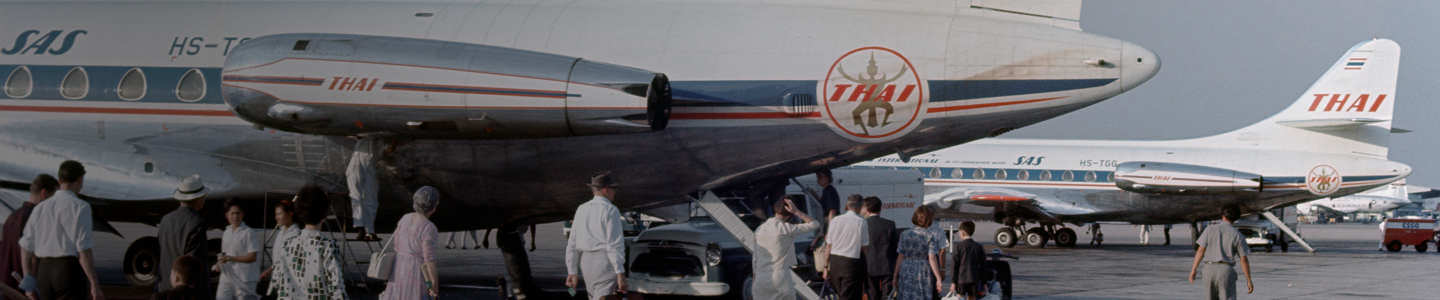
THAI has gradually emerged as the leading airline in Southeast Asia, recognized for its service excellence. The incorporation of the Caravelle SE-210 jet aircraft into our fleet brought the total number of jets to five. To promote Thai culture and enhance our brand, we introduced the warmth of Thai hospitality into our in-flight service, training our air hostesses to embody this welcoming spirit. Furthermore, THAI proudly showcased Thai talent by appointing Thai captains alongside international pilots. Since then, all THAI captains have been Thai nationals. In a special honor, the airline awarded the position of Honorary Flight Attendant to Miss Apasra Hongsakula, the reigning Miss Universe at the time.

In addition, THAI launched its first comprehensive tourism package under the brand "THAI Royal Orchid Holidays," (ROH) offering tailored travel solutions, including accommodations and sightseeing tours. This initiative not only strengthened Thailand's image as a premier tourist destination but also solidified THAI's position as a key player in the aviation and tourism industries.

THAI saw increased profits compared to previous years, reaching 3.9 million Baht, which significantly contributed to the company’s operational performance.
THAI has consistently improved its service, reaching 100,000 passengers, which reflects our commitment to excellence. In line with our forward-looking vision, we have added the 72-seat Caravelle SE-210 aircraft from France to our fleet and expanded our route to Osaka, Japan, in response to the increasing demand from our customers.
During this year, the state launched its first National Economic and Social Development Plan (1961-1966), aimed at driving economic growth and increasing income for the Thai people. At that time, THAI operated out of a modest three-story business building with only 600 staff members. Despite these humble beginnings, we were committed to enhancing our services by partnering with South East Airlines and expanding our air routes to include Hong Kong-Kolkata and Bangkok-Singapore, providing greater convenience for our valued customers.
Traveling by plane was considered a privilege 50 years ago, and THAI aimed not only to provide this exclusive experience to our clients but also to contribute to the Thai society. In 1962 (Thai year 2505), THAI introduced the Convair Coronado 990, a medium-sized passenger aircraft with a capacity of 99 seats. Renowned for its high-speed performance at the time, to replaced Douglas DC-6B aircraft. His Majesty the King and Her Majesty the Queen graciously presided over the inauguration of this maiden flight. In the same year, we increased our registered capital from 2 million to 40 million baht, a figure that clearly reflects the success of our services.
The airline continued to expand, and the number of passengers grew significantly. By 1961, THAI had carried over 83,000 passengers. The airline emphasized modernizing its fleet and expanding routes to accommodate increasing international travel demands. THAI’s exceptional Thai-style service was praised globally, reinforcing its reputation as a premium international airline. Additionally, this period marked Thailand's positioning as a key aviation hub in Asia, helping establish THAI as a major player in the global airline industry.

Thai Airways International (THAI) was founded in 1960 as a joint venture between Thailand's domestic carrier, Thai Airways Company (TAC) and Scandinavian Airlines System (SAS) with SAS held 30% of the shares while the Thai government owned 70%. SAS also provided operations, managerial and marketing expertise, with training assistance aiming at building a fully independent national airline within the shortest possible time.

On May 1, 1960, Thai Airways International (THAI) inaugurated its first international flight, using the Douglas DC-6B aircraft with a capacity of 60 seats. The routes included Bangkok to Hong Kong, Taipei, and Tokyo, before expanding further to Yangon, Kolkata, Kuala Lumpur, Singapore, Phnom Penh, Saigon, Manila, Jakarta in the same year. The planes were named after significant historical Thai royal family, such as Suranaree, Sri Sunthon, and Thao Thep Kasattri. By the end of the year, the airline had flown approximately 62,000 passengers across 11 routes. The distinctive “Dancing Man” logo was introduced to symbolize the airline's commitment to blending Thai elegance with global aviation standards.