A Legacy of Prestige and Innovation
On December 31, 2023, Thai Smile Airways officially merged into Thai Airways International (THAI) as part of the airline’s fleet and service integration strategy. The full cessation of THAI Smile’s operations took effect on January 1, 2024.
As part of the merger, 20 Airbus A320-200 aircraft were transferred to THAI’s fleet, enabling the airline to enhance its regional network while maintaining efficiency and service quality. This integration aimed to streamline operations, optimize resources, and provide passengers with a more seamless travel experience under the THAI brand.
THAI expanded its network with a new route to Brussels, further strengthening its presence in Europe.
In July 2012, Thai Smile Airways was launched as a regional carrier offering light-premium services, bridging the gap between low-cost carriers and full-service airlines.
On December 25, 2009, THAI took a step toward environmental responsibility by introducing carbon footprint labeling on in-flight meal containers. This initiative highlights the carbon dioxide emissions associated with each meal, encouraging passenger awareness and cooperation in reducing greenhouse gases.
The labeled menus include Massaman curry with jasmine rice, chicken green curry with jasmine rice, pork panaeng, roast duck red curry, chicken with basil, and ruby fish chu chee.
In the same year, THAI expanded its European network by launching direct flights to Oslo, marking its 13th destination in Europe.
This year, THAI Catering signed a Memorandum of Understanding (MoU) with the Islamic Committee of Samut Prakan Province to certify its kitchens for Halal food preparation. This ensures that Muslim passengers receive meals that fully comply with Islamic principles.
Trained Muslim staff oversee raw materials and meal preparation, ensuring strict adherence to Halal standards. THAI Catering has also expanded its Halal meal service to 10 Muslim airlines and other carriers upon request.
THAI commenced full operations at Suvarnabhumi Airport while continuing to support the government’s policy by maintaining domestic flights from Don Mueang Airport.
In the same year, THAI’s Royal First Class Lounge at Suvarnabhumi Airport was named “Best in the World” by the Skytrax World Airline Survey, recognizing its exceptional service and luxury.
THAI also expanded its network with new routes to Gaya and Varanasi, catering to passengers traveling on pilgrimage journeys.
THAI connected airspace across all five continents and launched a non-stop route to Johannesburg, South Africa, strengthening its global network.
On September 28, 2006, THAI relocated operations to Suvarnabhumi Airport (now Bangkok International Airport), moving over 1.8 million pieces of equipment and key departments, including THAI Technicians, THAI Catering, THAI Ground Services, Warehousing, and Operations.
As part of this transition, THAI unveiled a state-of-the-art THAI flight kitchen near the airport, capable of producing 87,000 meals daily. The facility also provides apron and ground services to over 80 airlines, reinforcing THAI’s role as a leading aviation service provider.
After three decades, THAI refreshed its brand identity, marking a significant transformation. The iconic symbol was refreshed with deeper, richer shades of purple, golden yellow, and vibrant magenta, enhancing its elegance and sophistication. The word "THAI" was prominently displayed in uppercase letters, symbolizing the airline’s strength, stability, and unwavering commitment to excellence.
That same year, THAI expanded its network with non-stop flights from Bangkok to New York, Los Angeles, and Moscow, reinforcing its global presence.
As competition in the aviation industry intensified across the region, THAI implemented a key strategy by launching Nok Air, a low-cost airline in which it held a 39% majority stake. Nok Air was established to expand domestic routes and compete with other budget carriers in the market.
Meanwhile, THAI celebrated a successful year, reporting a profit of 12,453 million baht and expanding its network with new routes to Milan and Bangalore.
THAI supported the transportation of two giant pandas, Chuang Chuang and Lin Hui, from the People's Republic of China by operating a special Airbus A330-300 flight. These pandas, serving as goodwill ambassadors, were safely brought to Thailand.
Additionally, THAI expanded its fleet with the addition of two Boeing 747-400 aircraft. The airline also successfully secured new co-investors, both domestic and international, with a total investment value of 285 million baht.
As part of its expansion, THAI introduced new flight routes to Shanghai, China; Chennai, India; and Luang Prabang, Laos.
At a time when people around the world were concerned about the Y2K situation, THAI had been preparing its data systems (Data Processing) for three years in advance. This proactive approach allowed THAI to navigate the situation smoothly.
In the same year, THAI launched its Royal e-Service, enabling passengers to make seat reservations, issue tickets, pay fares, and check in electronically.
THAI began privatization. The shares will be sold on the stock exchange of Thailand, amounting to 100 million shares. The company can raise funds up to 14,000 million baht and has more than 1,000,000 employees.
18,000 passengers to serve more than 8 million passengers on 71 routes.
THAI initiated the Royal Executive Class, business class service to increase Convenience and support service to the increasing number of business travelers traveling with THAI. Passengers in this class will receive special services. There is a special counter for check-in. There is a guest room. While waiting to board the plane, There are separate cabins on board. And served with special food and wine
In addition, THAI has also invested in the company. Bangkok Aviation Fuel Services Limited (BAFS) Royal Orchid Hotel, and the Airport Hotel
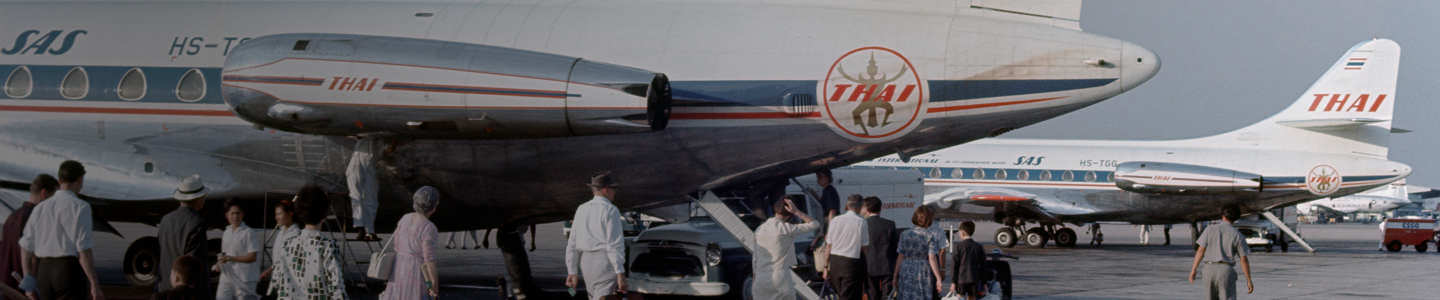
THAI has gradually emerged as the leading airline in Southeast Asia, recognized for its service excellence. The incorporation of the Caravelle SE-210 jet aircraft into our fleet brought the total number of jets to five. To promote Thai culture and enhance our brand, we introduced the warmth of Thai hospitality into our in-flight service, training our air hostesses to embody this welcoming spirit. Furthermore, THAI proudly showcased Thai talent by appointing Thai captains alongside international pilots. Since then, all THAI captains have been Thai nationals. In a special honor, the airline awarded the position of Honorary Flight Attendant to Miss Apasra Hongsakula, the reigning Miss Universe at the time.
In addition, THAI launched its first comprehensive tourism package under the brand "THAI Royal Orchid Holidays," (ROH) offering tailored travel solutions, including accommodations and sightseeing tours. This initiative not only strengthened Thailand's image as a premier tourist destination but also solidified THAI's position as a key player in the aviation and tourism industries.
Thai Airways International (THAI) was founded in 1960 as a joint venture between Thailand's domestic carrier, Thai Airways Company (TAC) and Scandinavian Airlines System (SAS) with SAS held 30% of the shares while the Thai government owned 70%. SAS also provided operations, managerial and marketing expertise, with training assistance aiming at building a fully independent national airline within the shortest possible time.
On May 1, 1960, Thai Airways International (THAI) inaugurated its first international flight, using the Douglas DC-6B aircraft with a capacity of 60 seats. The routes included Bangkok to Hong Kong, Taipei, and Tokyo, before expanding further to Yangon, Kolkata, Kuala Lumpur, Singapore, Phnom Penh, Saigon, Manila, Jakarta in the same year. The planes were named after significant historical Thai royal family, such as Suranaree, Sri Sunthon, and Thao Thep Kasattri. By the end of the year, the airline had flown approximately 62,000 passengers across 11 routes. The distinctive “Dancing Man” logo was introduced to symbolize the airline's commitment to blending Thai elegance with global aviation standards.