
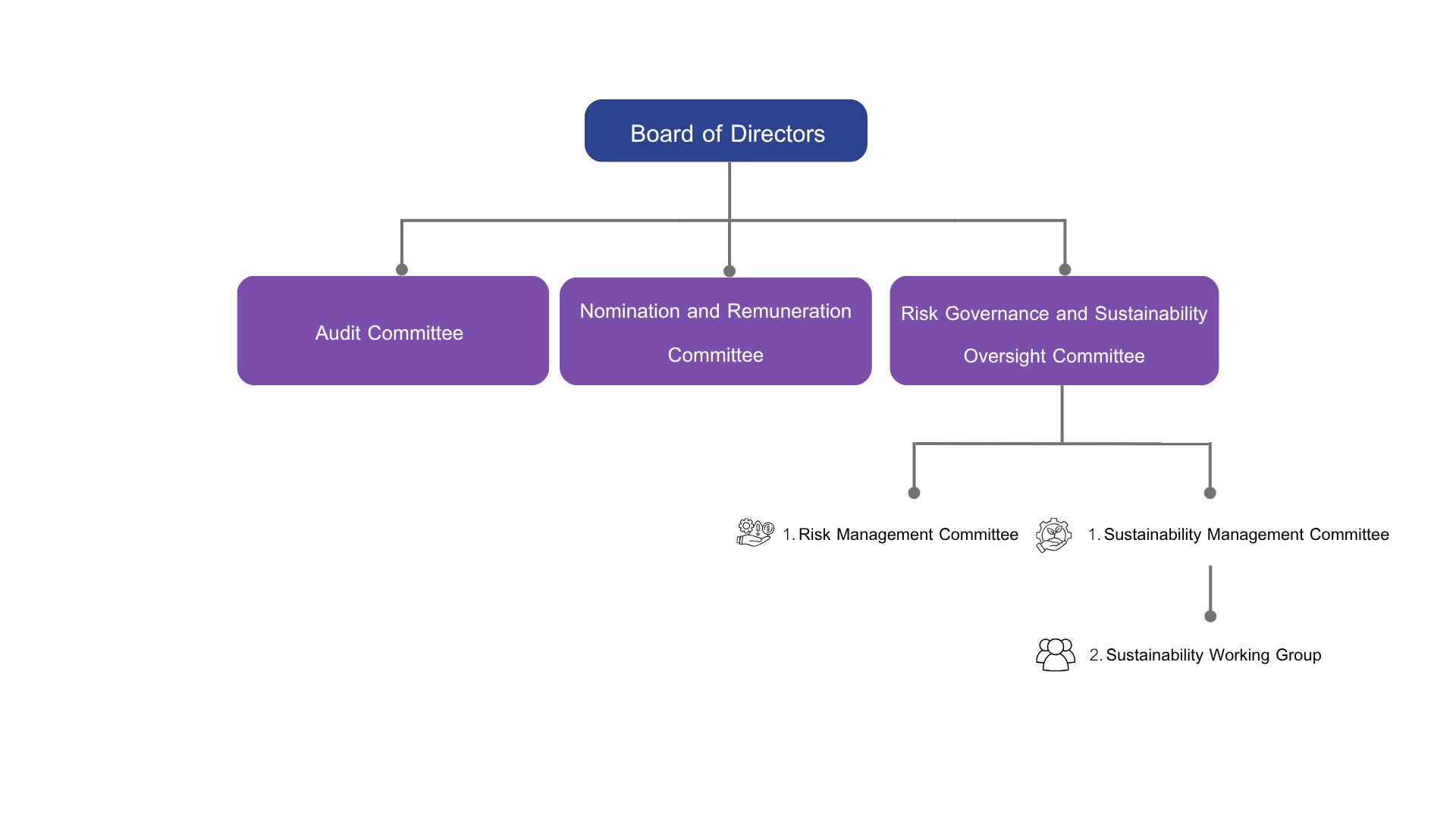
THAI Airways International Public Company Limited places great importance on sustainability governance and has established a clear governance structure to oversee, direct, and drive the implementation of its sustainability strategy in alignment with the Company's corporate strategy, good governance principles, and stakeholder expectations. The Company values stakeholder engagement by providing various communication channels, including its website, e-mail, social media, surveys, meetings, and stakeholder engagement activities, through which stakeholders can communicate their ESG-related feedback. The Company reviews and considers stakeholder input and incorporates it into the development, implementation, and continuous improvement of its sustainability management and ESG initiatives. The Sustainable Development function serves as the focal point for coordinating, driving, and monitoring the Company's sustainability initiatives. The Company's sustainability governance structure is presented below.
Roles and Responsibilities
- Oversee and provide recommendations on the Company's strategies, policies, objectives, and action plans relating to risk management, corporate governance, and sustainability to ensure alignment with the Company's strategic direction and good corporate governance principles.
- Oversee, monitor, and support the implementation of risk management, corporate governance, and sustainability initiatives, including the oversight of sustainability-related risks and opportunities, to ensure the achievement of the objectives and policies approved by the Board of Directors.
- Oversee and monitor fraud and corruption risk management, and promote the establishment of appropriate governance, internal control, and compliance systems.
- Review, provide recommendations on, and monitor the disclosure of information relating to risk management, corporate governance, and sustainability, including the Annual Report (Form 56-1 One Report) and the Sustainability Development Report.
- Review and endorse reports on the Company's risk management, corporate governance, and sustainability performance prior to submission to the Board of Directors.
- Request information or supporting documents, invite relevant persons to provide clarification, and appoint subcommittees, working groups, or external advisors, where necessary, to support the Committee in carrying out its duties.
- Perform other duties as assigned by the Board of Directors.
- The Committee shall meet at least once every quarter and may convene additional meetings as necessary to oversee the Company's risk management, corporate governance, and sustainability matters.
Roles and Responsibilities
- Formulate, review, and drive the implementation of the Company's risk management policies, strategies, objectives, key performance indicators (KPIs), and action plans to ensure alignment with the Company's strategic direction.
- Oversee, monitor, and drive the implementation of the Company's risk management framework in accordance with the approved policies, objectives, and action plans, and regularly report risk management performance to the Risk, Governance and Sustainability Oversight Committee (RGSOC).
- Oversee the preparation of risk management reports and submit the Company's risk management performance to the Risk, Governance and Sustainability Oversight Committee (RGSOC) for consideration prior to submission to the Board of Directors.
- Review and enhance the Company's risk management policies, processes, and action plans to ensure they remain responsive to the evolving business environment and emerging risks.
- Promote a risk-aware organizational culture and support the development of employees' knowledge, competencies, and capabilities in risk management across all levels of the organization.
- Oversee the disclosure of risk management information and related reports, including information disclosed in the Annual Report (Form 56-1 One Report).
- Request information or supporting documents and invite relevant persons to provide clarification, where necessary, to support the Committee in carrying out its duties.
- Perform other risk management-related duties as assigned by the Risk, Governance and Sustainability Oversight Committee (RGSOC) or the Board of Directors.
Roles and Responsibilities
- Formulate, review, and drive the implementation of the Company's sustainability policies, strategies, objectives, key performance indicators (KPIs), and action plans, ensuring alignment with the Company's strategic direction, stakeholder expectations, and material sustainability topics (ESG Materiality).
- Oversee, monitor, and drive the implementation of sustainability initiatives to achieve the Company's sustainability objectives while integrating ESG considerations across all business functions.
- Review and monitor environmental, social, governance, and sustainability-related risks and opportunities, and report sustainability performance to the Risk, Governance and Sustainability Oversight Committee (RGSOC).
- Promote sustainability awareness, knowledge, and capability development among employees to strengthen ESG implementation across the organization.
- Oversee the disclosure of sustainability information and related reports to ensure compliance with applicable requirements and recognized standards.
- Perform other sustainability-related duties as assigned by the Risk, Governance and Sustainability Oversight Committee (RGSOC) or the Board of Directors.
The Working Group comprises representatives from all business functions across the Company. Members represent their respective functions and coordinate with relevant departments to drive the implementation of sustainability initiatives across the organization. Its roles and responsibilities are as follows:
- Develop and periodically review the Company's sustainability action plans to ensure alignment with material sustainability topics (ESG Materiality), the Company's strategic direction, and the Sustainability Strategic Framework.
- Coordinate, supervise, monitor, and support sustainability implementation across all business units to achieve the established objectives and performance indicators.
- Drive ESG implementation in accordance with the Company's Good Corporate Governance Policy, Sustainability Management Policy, corporate vision, mission, and core values, while supporting sustainability initiatives across business functions.
- Promote sustainability communication, awareness, and organizational culture, and coordinate the collection and disclosure of environmental, social, and governance (ESG) information in accordance with applicable standards.
- Report sustainability performance to the Sustainability Management Committee (SMC) on a regular basis, at least once every quarter.
- Perform other sustainability-related duties as assigned by the Sustainability Management Committee (SMC).
- The Working Group shall meet at least once every quarter and may convene additional meetings as necessary to monitor progress and drive the implementation of the Company's sustainability initiatives.
Roles and Responsibilities
- Serve as the focal point for coordinating, driving, and monitoring the Company's sustainability initiatives in alignment with the Company's strategic direction.
- Support the Risk, Governance and Sustainability Oversight Committee (RGSOC), the Sustainability Management Committee (SMC), and the Sustainability Working Group (SWG), and serve as the secretariat to the relevant committees and working group.
- Develop and periodically review sustainability policies, strategies, objectives, action plans, and key performance indicators (KPIs), while supporting the integration of ESG considerations across all business functions.
- Coordinate with internal functions and external stakeholders to collect sustainability information, monitor performance, and drive sustainability initiatives throughout the organization.
- Prepare and disclose sustainability information, reports, and related disclosures in accordance with applicable standards, regulations, and reporting frameworks.
- Monitor emerging sustainability trends, regulations, standards, and reporting frameworks, and recommend improvements to strengthen the Company's sustainability performance.
- Promote sustainability awareness, knowledge, and organizational culture through communication, training, and engagement activities.
- Perform other sustainability-related duties as assigned by management or the relevant committees.