

Thai Airways Internation Public Company Limited is committed to minimizing environmental impacts from its operations and achieving Net-Zero 2050. The Company has established processes for measuring, controlling, and managing greenhouse gas emissions from its various activities, with annual verification conducted by external agencies.
Additionally, THAI monitors greenhouse gas emissions in accordance with the GHG Protocol Corporate Accounting and Reporting Standard established by the World Resources Institute. The Company also assesses the full lifecycle emissions of its products in alignment with the GHG Protocol Corporate Value Chain Standard, covering Scope 1-3 emissions. The company reports greenhouse gas emissions under its operational control from the activity operating in 2025. The Company’s assessment scope includes carbon dioxide (CO2), methane (CH4), nitrous oxide (N2O), hydrofluorocarbons (HFCs), perfluorocarbons (PFCs), sulfur hexafluoride (SF6), and nitrogen trifluoride (NF3) as part of its emissions reporting.
The table shows greenhouse gas emissions data for the years 2025
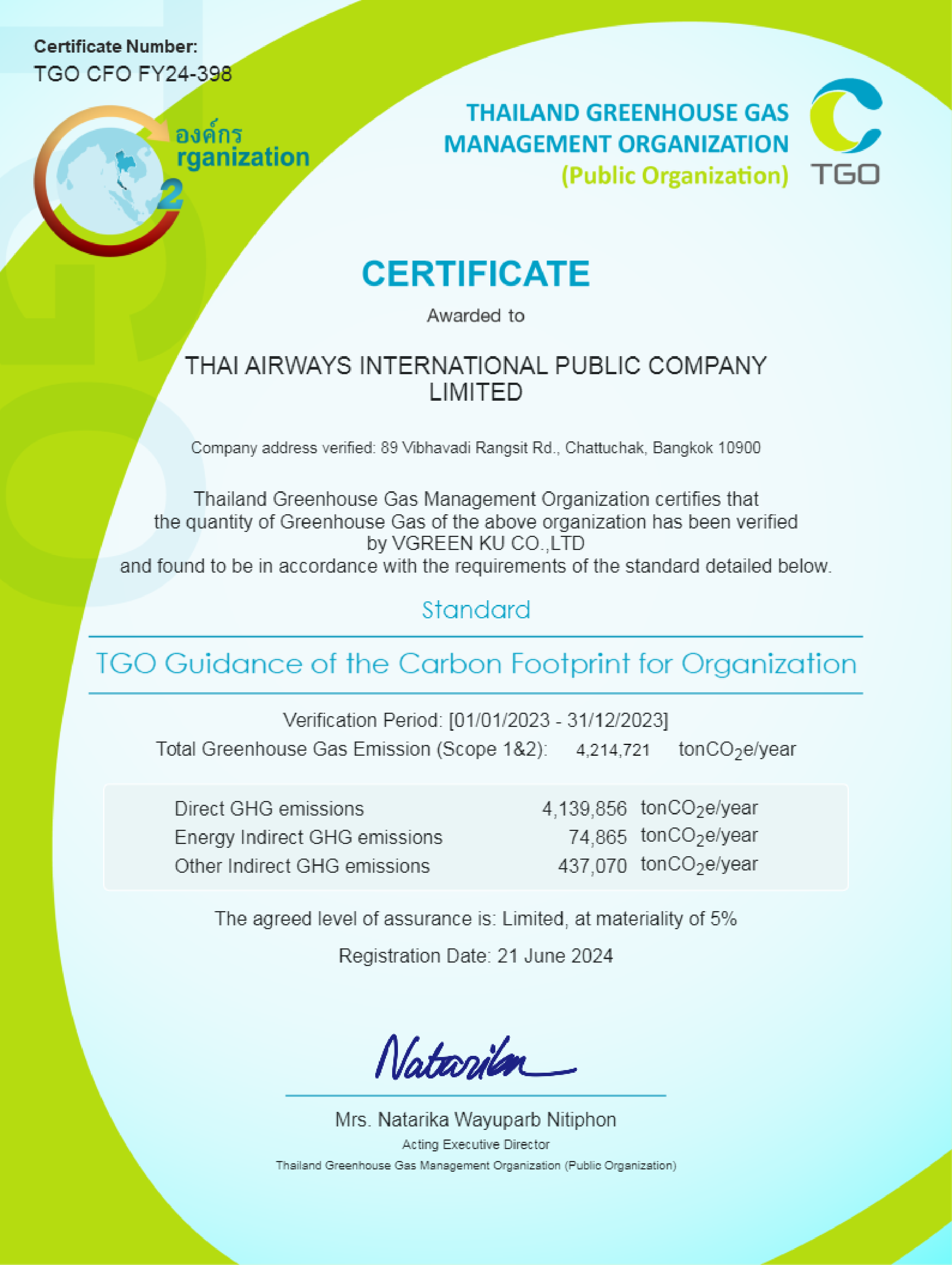
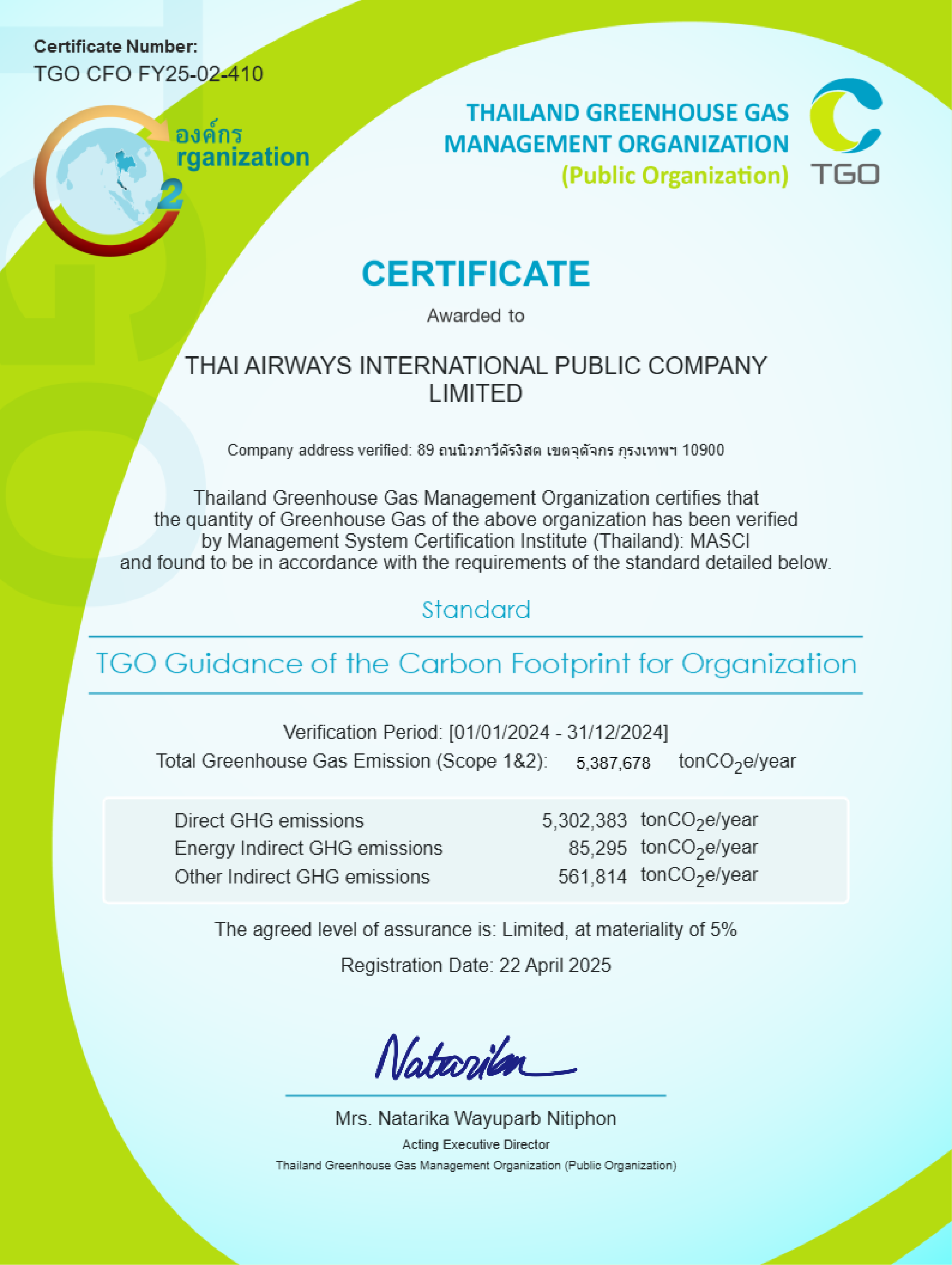
| Types of greenhouse gas emissions (Unit: Tons of Co2 Equivalent) | Year 2023 | Year 2024 | Year 2025 |
|---|---|---|---|
| Direct Emissions (Scope 1) | 4,139,856 | 5,302,383 | 5,679,259 |
| Carbon dioxide emissions from biological processes (separate report) | - | - | 16,743 |
| Indirect greenhouse gas emissions from the purchase of electricity, steam, and biogas (Scope 2) | 74,865 | 85,295 | 86,475 |
Other indirect greenhouse gas emissions (Scope 3) Category 3: Fuel-and energy-related activities only |
437,070 | 561,814 | 603,852 |
| Total greenhouse gas emissions (Scope 1 and Scope 2) | 4,214,721 | 5,387,678 | 5,765,734 |
| Total greenhouse gas emissions (Scope 1, Scope 2, and Scope 3) | 4,651,791 | 5,949,492 | 6,369,586 |
The Greenhouse gas report has been verified at a limited level of assurance at 5% in accordance with Carbon footprint for Organization standard by TGO and ISO 14064-1, conducted by the Management System Certification Institute (Thailand) (MASCI).
_EN_TG_(2026).png)
Greenhouse Gas Management Action Plan
The Company has developed a greenhouse gas (GHG) emission reduction plan, modeled according to SBTi in the Aviation Guidance group, but has not yet sought certification from international accreditation bodies. Furthermore, the Company has been reporting greenhouse gas emissions in accordance with CORSIA measures, specifically for routes where the destination country is subject to the same measures. The Company has a plan to procure carbon credits to comply with CORSIA measures, which mitigates regulatory risks related to climate change that could impact financial performance. The Company has a plan for managing greenhouse gas emissions by utilizing carbon dioxide emission data from internal organizational activities (Carbon Footprint for Organization) for reporting to the Thailand Greenhouse Gas Management Organization (TGO) and an Emissions Report for submission to the Civil Aviation Authority of Thailand (CAAT).
Performance and Outcomes of Greenhouse Gas Management
The Company has developed a greenhouse gas emission reduction plan by modeling according to SBTi in the Aviation Guidance group but has not yet sought certification from international certification bodies. Furthermore, the Company has been reporting greenhouse gas emissions in accordance with CORSIA measures, by reporting only on routes where the destination country is under the same measures. The Company has a plan to procure carbon to comply with CORSIA measures, which reduces regulatory risks related to climate change that could have financial implications.
The Company has a greenhouse gas emission management plan, utilizing carbon dioxide emission data from internal organizational activities (Carbon Footprint for Organization) for reporting to the Thailand Greenhouse Gas Management Organization (TGO), and an Emissions Report for reporting to the Civil Aviation Authority of Thailand (CAAT).
In addition, first-class passengers have access to the à la carte inflight meal service. This service offers an expanded selection of meal options, including fine menu choices beyond the standard menu available for other passengers.
These services ensure a more personalized dining experience for the class travelers.

Thai Airways International maintains a diverse and well-balanced fleet as part of its ongoing fleet modernization strategy, designed to support evolving network demands while enhancing operational efficiency.
As of 2025, Thai Airways has an average age of approximately 10.7 years, reflecting a continued transition toward a younger and more efficient fleet profile. This metric is calculated based on aircraft under both owned and leased portfolios.
The fleet comprises a mix of next-generation and existing aircraft, including A320-200, A321neo, A330-300, A350-900, Boeing 777-200ER, 777-300ER, 787-8 และ Boeing 787-9 enabling the Company to efficiently serve both regional and long-haul markets while progressively improving fuel efficiency and environmental performance.
Through its fleet modernization program, the Company continues to optimize its fleet structure through disciplined capital allocation, including fleet renewal, lease portfolio management, and redelivery planning. These efforts aim to enhance passenger experience through modern cabin products and technology, while improving cost efficiency and supporting the Company’s long-term sustainability objectives.
Fleet Age and Average Fleet age
| Aircraft | Number | Age | Remark | ||
|---|---|---|---|---|---|
| 2023 | 2024 | 2025 | |||
| Airbus A320-200 | 20 | 9.9 Years | 10.9 Years | 11.9 Years | |
| Airbus A321NEO | 1 | - | - | 0.1 Years | Operate since December 2025 |
| Airbus A330-300 | 5 | 13.3 Years | 14.3 Years | 15.3 Years | |
| Airbus A350-900 | 23 | 5.7 Years | 6.7 Years | 7.7 Years | |
| Boeing 777-200 | 3 | 16.8 Years | 17.8 Years | 18.6 Years | |
| Boeing 777-300 | 17 | 8.5 Years | 9.5 Years | 10.5 Years | |
| Boeing 787-8 | 6 | 9.0 Years | 10.0 Years | 11.0 Years | |
| Boeing 787-9 | 4 | 5.7 Years | 5.8 Years | 5.9 Years | |
| TOTAL | 80 | 8.8 Years | 9.8 Years | 10.7 Years | |
Additionally, it can be blended with current fossil fuels at an increasingly commercial-scale standard under the International Civil Aviation Organization (ICAO) and the European Fuel Transport Association.
Thai Airlines also supports the European Union’s framework for progressively increasing SAF blending ratios in future batch imports from European suppliers.
Thai Airways is committed to preserving the environment for sustainable growth in the future through proactive measures that will be gradually implemented in years to come.
This project has a net final future impact on Thai Airlines, and in 2023, the company was able to reduce aircraft fuel consumption by approximately 171,339 tons of CO2.
At the 39th Assembly of the International Civil Aviation Organization (ICAO), a resolution was adopted to implement the Carbon Offsetting and Reduction Scheme for International Aviation (CORSIA) as a global measure to offset and reduce carbon dioxide emissions from international aviation. Under this framework, the civil aviation authority of each country is designated as the regulatory body responsible for overseeing and ensuring compliance with the scheme.
In Thailand, the Civil Aviation Authority of Thailand (CAAT) has prepared for the implementation of CORSIA by requiring airlines to appoint responsible representatives, prepare and submit an Emission Monitoring Plan, and submit Annual Emission Reports in accordance with the prescribed requirements.
The Company began preparing carbon dioxide emission reports under the CORSIA framework in 2019 and has continuously submitted such reports to the Civil Aviation Authority of Thailand in compliance with the applicable requirements, thereby supporting efforts to mitigate climate change impacts arising from international aviation.
| Year | Total CO2 emissions from international flights (in tonnes): | Total number of international flights during reporting period: |
|---|---|---|
| 2019 | 7,235,337 | 63,303 |
| 2020 | 1,730,038 | 14,987 |
| 2021 | 750,865 | 6,913 |
| 2022 | 2,837,600 | 24,101 |
| 2023 | 4,186,721 | 40,243 |
| 2024 | 5,177,006 | 59,817 |
| 2025 | 5,577,205 | 62,941 |
In addition, the Company has complied with the requirements of the European Union Emissions Trading System (EU ETS) by preparing and submitting carbon dioxide emissions reports and carbon credit usage reports to the German Emissions Trading Authority (DEHSt), the regulatory authority of Germany, since 2012, in full compliance with the EU ETS requirements.
These actions reflect the Company’s strong commitment to adhering to international environmental standards and regulations, while effectively managing greenhouse gas emissions to support long-term sustainable growth objectives.